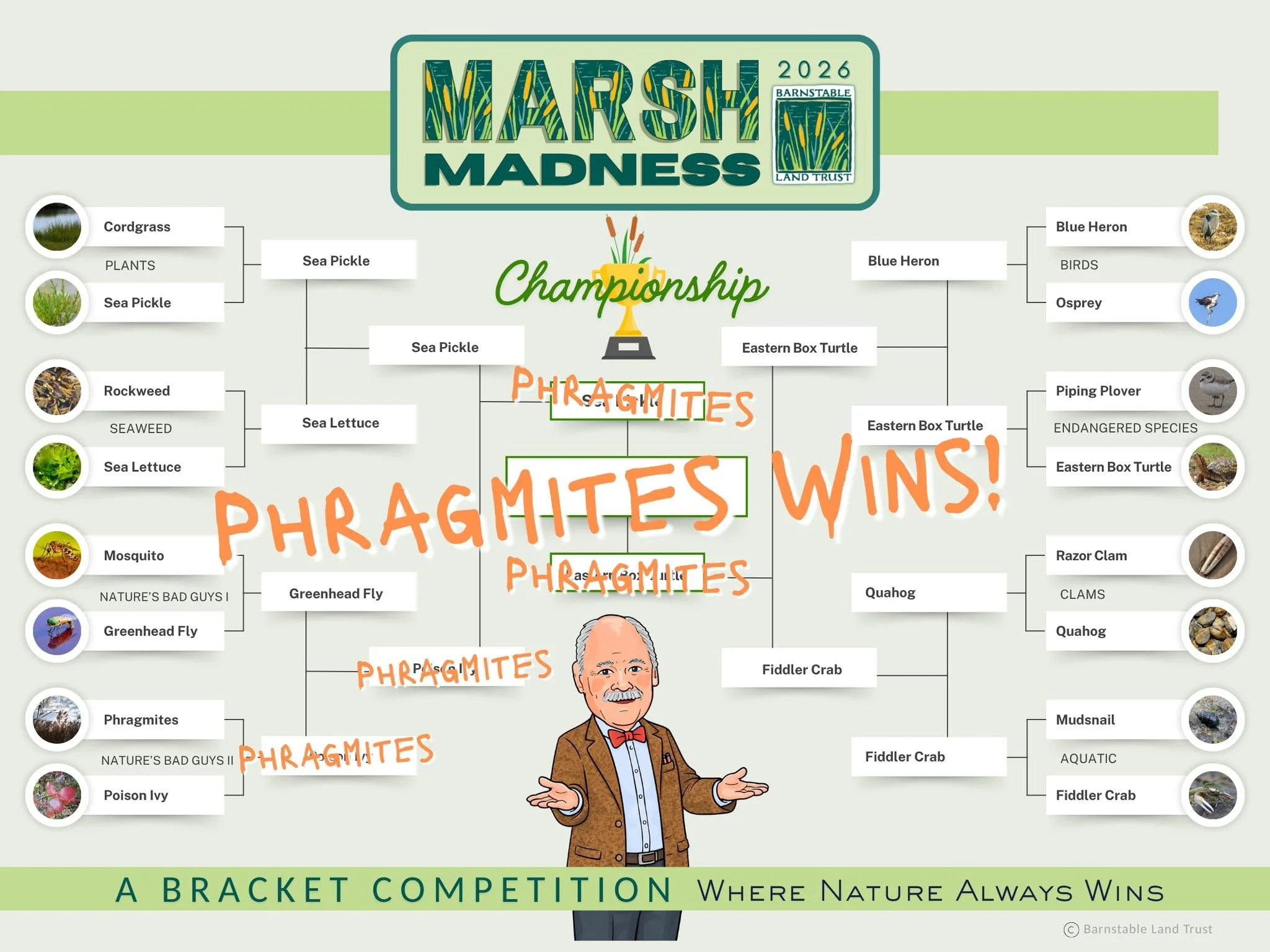
Salt air, strong tides, and serious bragging rights—welcome to Marsh Madness, Cape Cod–style. You don’t need a basketball bracket, a whistle, or a PhD in birding to play along—Barnstable Land Trust’s inaugural Marsh Madness is officially in session from February 22 – April 6.
Learn why every player has an important role within the marsh’s ecosystem and then vote to help us determine who is the 2026 Marsh Madness MVP!
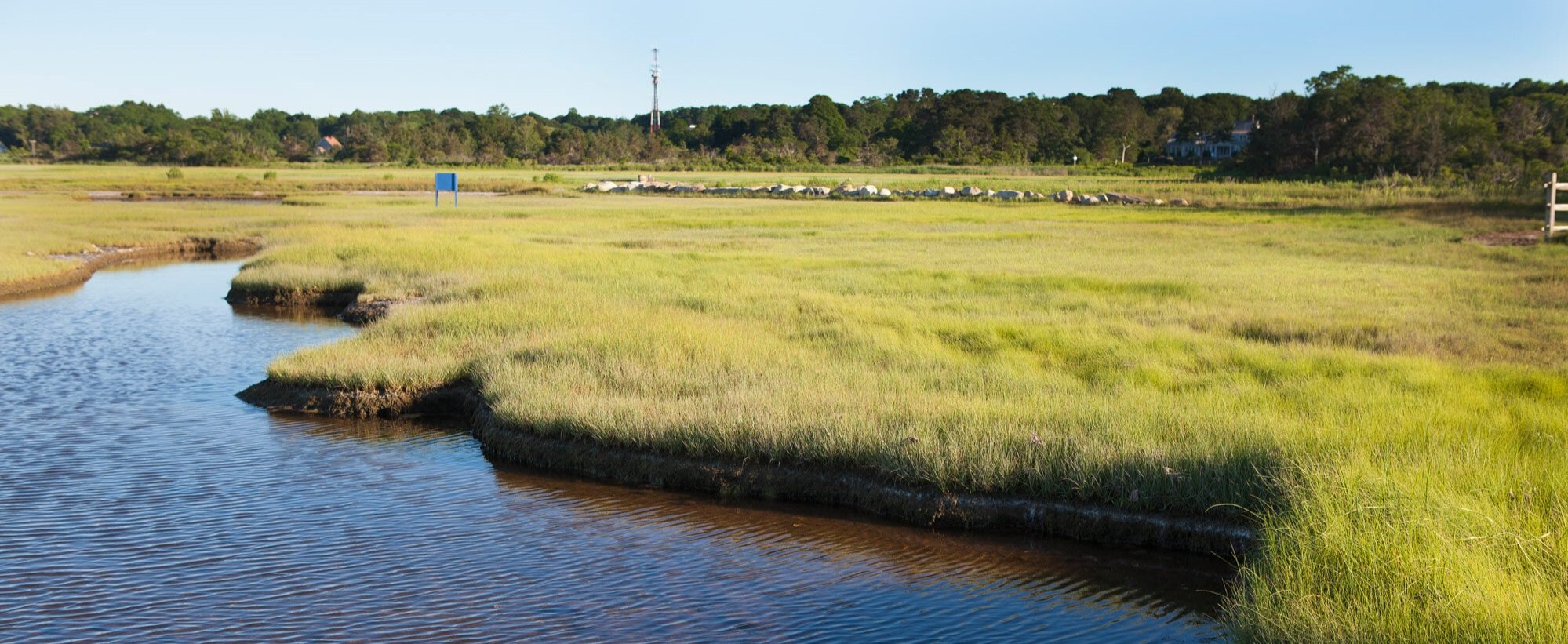
With more than 20,000 acres, Cape Cod’s marshes are the ultimate defensive line—buffering storms, fighting sea level rise, and taking on climate change like absolute champions. But the matchup is tough: according to the Association to Preserve Cape Cod (APCC), 36% (roughly 7,000 acres) of our historic salt marshes have already been lost or severely degraded.
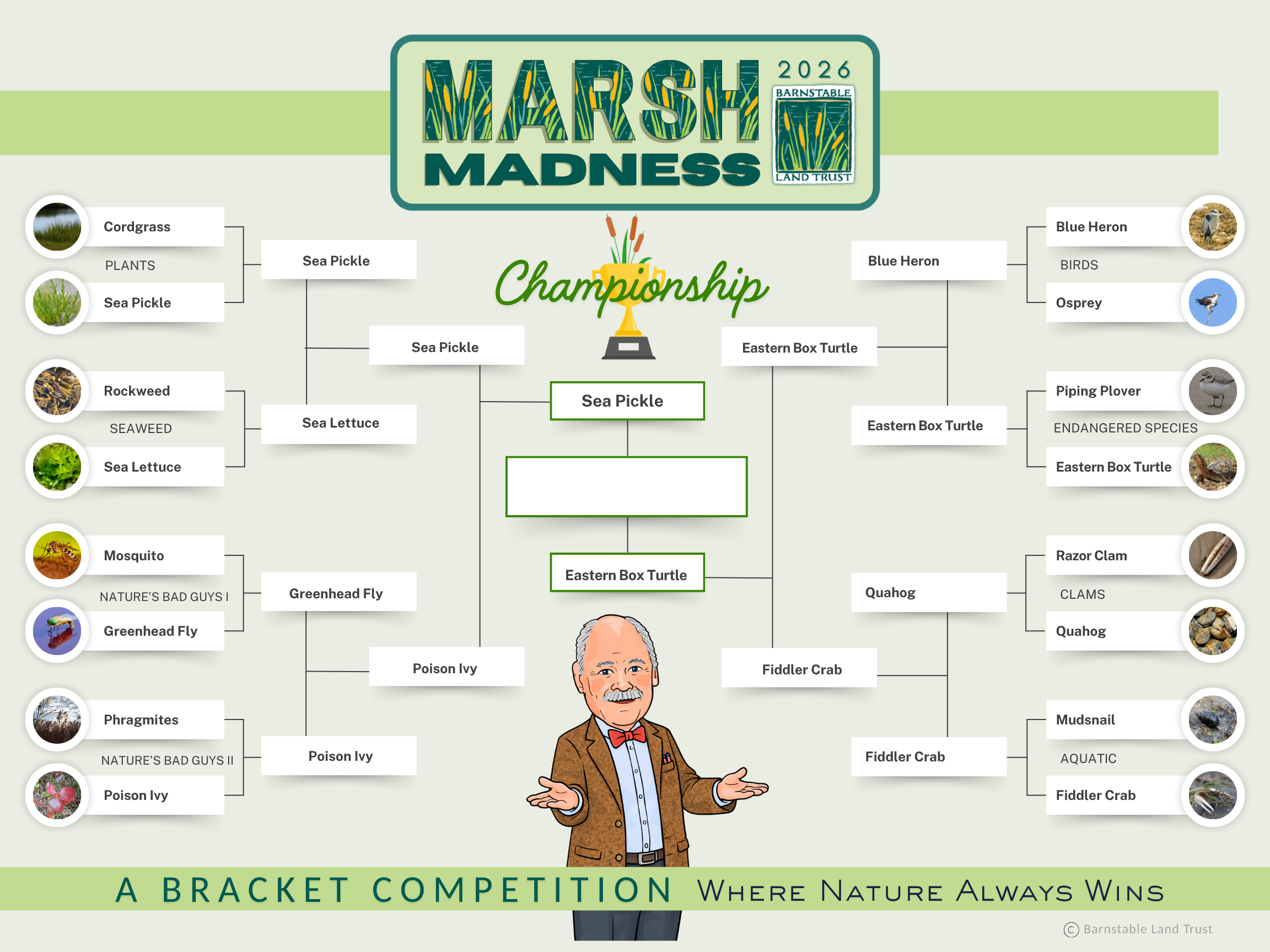
All March long, it’s game on. Meet the marsh’s top contenders—from plants and birds to insects, marine life, and other habitat heroes (and a few notorious villains). Cast your votes, build bragging rights, score a chance at a prize package, and help crown Cape Cod’s conservation champions in this truly wild Marsh Madness match-up
A special thanks to Gil Newton, one of BLT’s founders, author, and naturalist educator and to Jasmine Kohler, a student at Cape Cod Community College who provided background research.
This program is also supported in part by a grant from the Mid-Cape Cultural Council, a local agency which is supported by the Mass Cultural Council, a state agency.

To stand at the edge of the sea, to sense the ebb and flow of the tides, to feel the breath of a mist moving over a great salt marsh, to watch the flight of shore birds that have swept up and down the surf lines of the continents for untold thousands of years, to see the running of the old eels and the young shad to the sea, is to have knowledge of things that are as nearly eternal as any earthly life can be.
Rachel Carson
Join the madness.
The marsh is counting on you.
Meet the Contenders
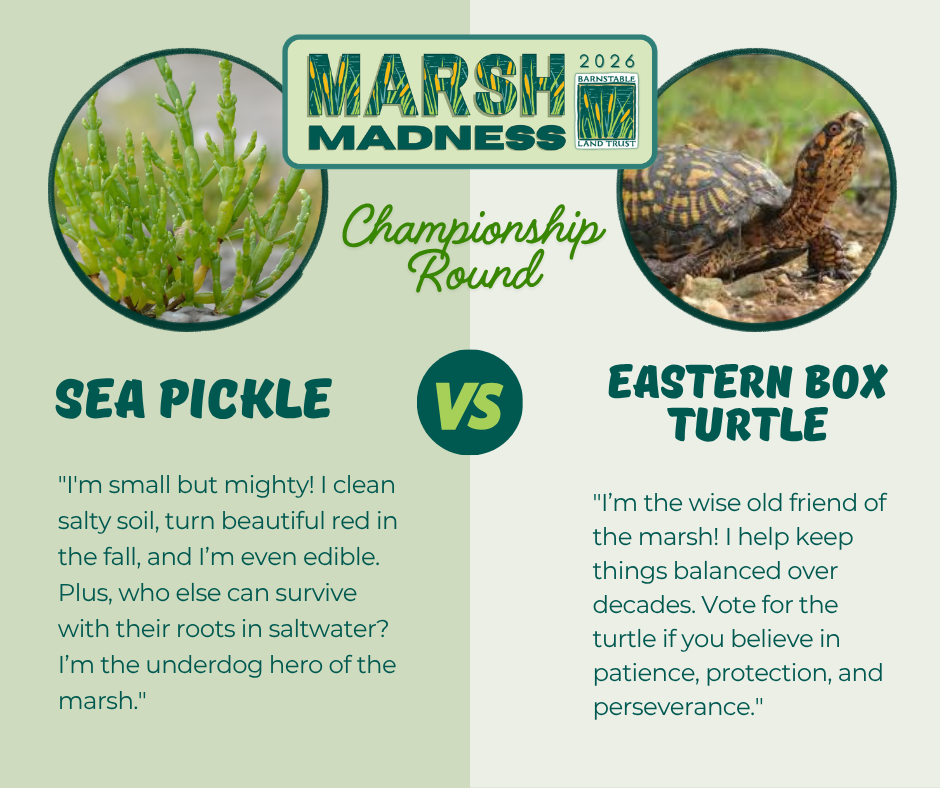
Championship Round Voting: Sunday, April 5 – Monday, April 6
-
(Salicornia europaea)
-
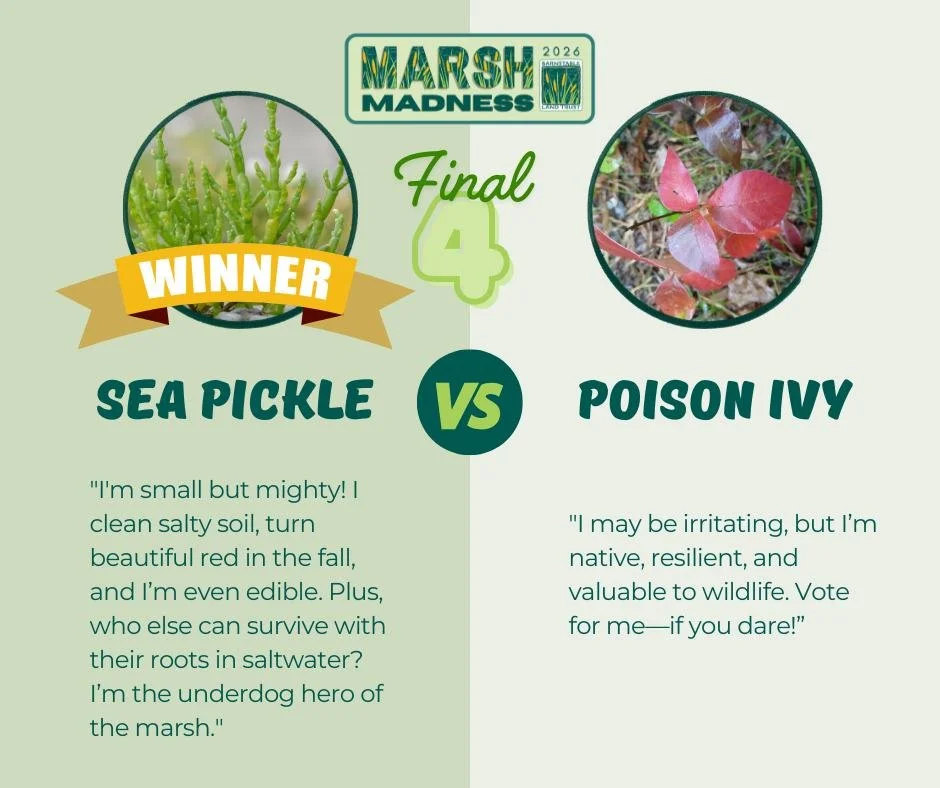
Also known as glasswort or marsh samphire, Sea Pickle is a succulent plant that thrives in salty soils. It grows in the higher parts of the marsh that flood only occasionally. Its fleshy, bright green stems turn reddish in the fall, and it’s often edible (sometimes pickled!). Sea Pickle is smaller than Cordgrass but equally important to the health of the marsh.
-
Grows 2–16 inches tall
No true leaves—just jointed, fleshy stems
Turns red or purple in fall
-
Edible and used in gourmet cooking
Stores salt in its tissues to survive salty soils
Sometimes called “poor man’s asparagus”
Can absorb heavy metals from the soil
-
Helps trap sediments, reduce salt buildup in soil, and support biodiversity in higher marsh zones.
-
Reduces soil salinity
Improves marsh elevation stability
Adds biodiversity
-
Less effective for erosion control
Sensitive to trampling and overharvesting
-
"I'm small but mighty! I clean salty soil, turn beautiful red in the fall, and I’m even edible. Plus, who else can survive with their roots in saltwater? I’m the underdog hero of the marsh."
Sea Pickle
-
(Terrapene carolina)
-
The Eastern Box Turtle is a land-dwelling reptile often found in forests, meadows, and edges of marshlands. It’s slow-moving but long-lived and is considered vulnerable due to habitat loss, roads, and collection by people.
-
Domed, high shell with yellow/orange patterns
Hinged shell allows it to close up tightly
Grows 4–8 inches long
-
Can live 40–100 years
Omnivore—eats mushrooms, insects, and fruit
Returns to the same area for life
Populations decline if even a few adults are lost
-
Helps control insects and spread seeds in surrounding upland habitats.
-
Long lifespan means long-term ecosystem contributions
Seed disperser and scavenger
-
Slow reproduction
Threatened by cars, habitat loss, and pet trade
Learn More: State of Massachusetts (.gov) information sheet here.
-
"I’m the wise old friend of the marsh! I help keep things balanced over decades. Vote for the turtle if you believe in patience, protection, and perseverance."
Eastern Box Turtle
Vote
Check back during voting windows to cast your vote.
Round 1 - Sweet Sixteen: Sunday, February 22 – Sunday, March 1
Round 2 - Elite Eight: Sunday, March 8 – Sunday, March 15
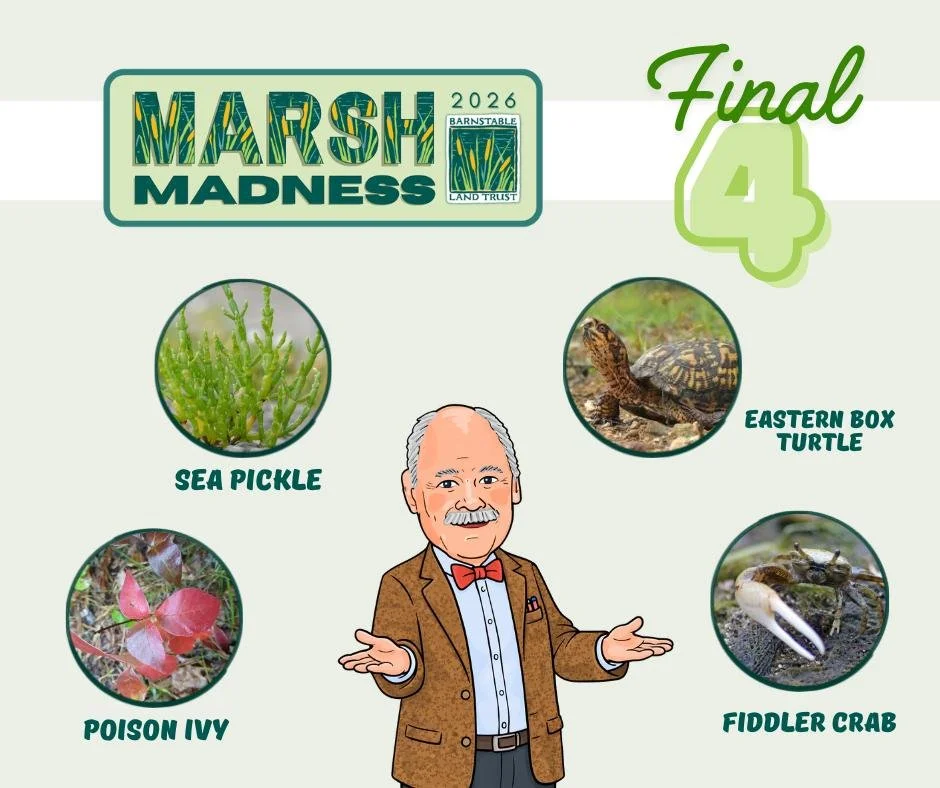
Round 3 - Final Four: Sunday, March 22– Sunday, March 29
Round 4 - Championship (2-day voting window): Sunday, April 5 – Monday, April 6
Frequently Asked Questions
-
An initiative of Barnstable Land Trust (BLT), Marsh Madness is an online bracket competition where people can vote for their “fan favorite” while learning more about the importance of Cape Cod’s Marshes. This month-long virtual event (February 22 – April 6) is naturally positioned to rival college basketball’s March Madness popularity, as the environment commands the center court.
This is a single elimination tournament. For each match-up, vote for your favorite conservation champion. The nature superstar with the most votes advances to the next round. Only one will be crowned Marsh Madness champion. Meet the heroes – and villains - of the marsh, and vote for your favorite!
-
Barnstable Land Trust’s mission is to protect and preserve the natural spaces and places that make Barnstable so special. We hope Marsh Madness is a fun and creative way to:
Help people realize how alive, competitive, and interconnected a salt marsh really is. Framing plants, birds, insects, and marine life as “contenders” gives people a reason to notice—and care about—species they might otherwise overlook.
Not everyone is ready to read a habitat report or attend a lecture. A game is welcoming, accessible, and fun—perfect for kids, families, seasonal residents, and year-round locals alike.
Voting, following along, and sharing information creates a shared experience rooted in Cape Cod’s landscapes. We hope a sense of local pride motivates a long-term investment in why stewardship is so important.
People learn about marsh ecology, threats, and conservation wins organically—and we wanted to make it fun!
In the marsh, survival really is a mix of adaptation, competition, and resilience. We hope that Marsh Madness illustrates why the work of Barnstable Land Trust and land conservation efforts regionally are so critical to the future health of Cape Cod’s environment.
-
-
Round 1 - Sweet Sixteen: Sunday, February 22 – Sunday, March 1
Round 2 - Elite Eight: Sunday, March 8 – Sunday, March 15
Round 3 - Final Four: Sunday, March 22– Sunday, March 29
Round 4 - Championship (2-day voting window): Sunday, April 5 – Monday, April6
-
Fans can vote here during the competition dates above or by clicking on the links in BLT’s enewsletter and social media posts.
-
Every time you cast a vote and include your email address, you will automatically be entered into the prize package drawing. This means you have the potential to be entered up to four times – so don’t forget to vote in each and every round!
-
Salt marshes are coastal wetlands that form a transition zone between land and sea. They are ever-changing environments that are regularly flooded by seawater (twice-daily in this region) as the tides rise and fall. Salt marsh habitats are essential for healthy fisheries, coastlines and communities and play a vital role to play in protecting Cape Cod against the harmful effects of sea level rise and a changing climate.
-
Cape Cod has over 20,000 acres of salt marshes, but human activity has damaged or degraded a significant portion of them.
-
Overdevelopment: Filling or draining salt marshes for agriculture, and building tidal barriers like dikes and tide gates
Pollution: Runoff from wastewater and fertilizer, which can cause algal blooms that lower oxygen levels in the water
Mosquito ditching: Creating unnatural cuts and barriers in the marsh
-
HERE Association to Preserve Cape Cod’s (APCC’s) presentation on Salt Marshes: Natural Protection in a Changing Climate (December 2025)
HERE APCC’s Fact Sheet: Salt Marsh Preservation and Restoration
HERE BLT’s Marshes of Barnstable presentation by BLT founder and naturalist Gil Newton (April 2022)
HERE National Park Service’s page on Salt Marsh Dieback on Cape Cod
Upcoming 2026 Gil Newton Programs where you can experience marsh magic:
May 23: Lady Slipper Walk at Crocker Neck (BLT events HERE)
May 30:Ecology and the Use of Seaweed at Osterville Village Library (BLT events HERE)
And don’t miss this special event:
State of the Harbor, Barnstable Village: April 11, details TBA
-
MassAudubon: Long Pasture Wildlife Sanctuary • Cummaquid • 101 Acres • 2.5 miles
Pogorelc Sanctuary • West Barnstable • 9.9 Acres • 0.4 mile
Sandy Neck Beach Park • West Barnstable • 1,188 Acres • 7.5 miles
Follow the Madness on Social Media.
Follow the Madness on Social Media.